Every recap I read on Friday called it a selloff. The tape says something more specific happened, and the difference matters if you own any of this.
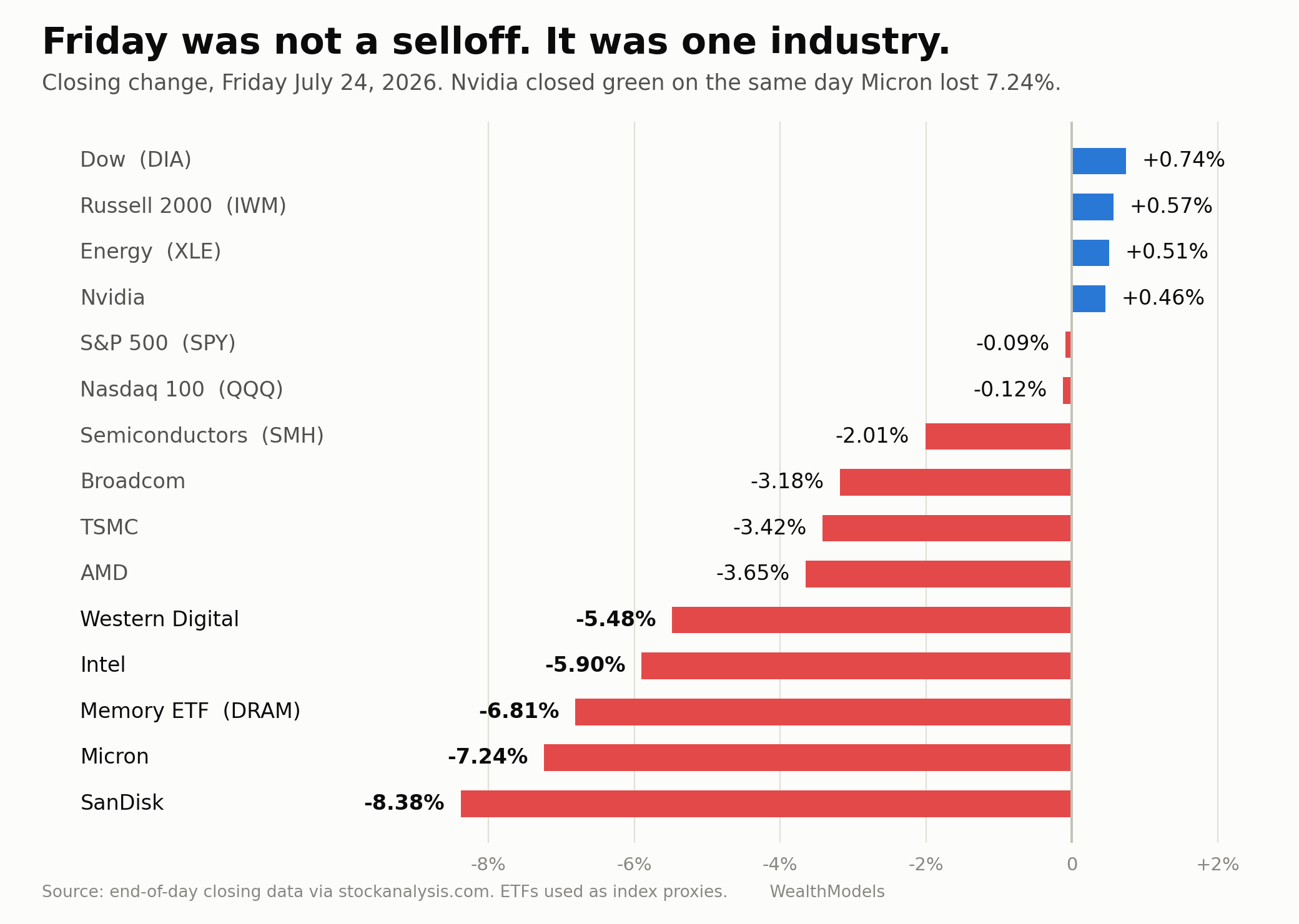
| Dow (DIA) | +0.74% |
| Russell 2000 (IWM) | +0.57% |
| Energy (XLE) | +0.51% |
| S&P 500 (SPY) | -0.09% |
| Nasdaq 100 (QQQ) | -0.12% |
| Semiconductors (SMH) | -2.01% |
The Dow finished up three quarters of a percent. Small caps were green. Energy was green. The S&P and the Nasdaq 100 both finished within a tenth of a percent of unchanged. That is not a selloff. That is a quiet Friday.
Now here is the same day for memory and storage.
| SanDisk | -8.38% |
| Micron | -7.24% |
| Roundhill Memory ETF (DRAM) | -6.81% |
| Intel | -5.90% |
| Western Digital | -5.48% |
| AMD | -3.65% |
| TSMC | -3.42% |
| Broadcom | -3.18% |
| Nvidia | +0.46% |
Nvidia closed green on the same day Micron lost more than seven percent. Sit with that for a second, because it rules out the explanation most people reached for.
This was not an AI unwind
If Friday were the AI trade cracking, Nvidia does not finish up while SanDisk finishes down eight and a half. The whole complex would move together. It did not. The damage sorted itself almost perfectly by distance from a DRAM or NAND wafer. Memory got destroyed, storage got hit hard, foundry and compute got scratched, and the company most exposed to AI demand closed higher.
Semis as a group lost two percent. Micron alone lost more than three times that. When an industry index falls far less than its constituents, you are looking at a subgroup being liquidated, not a sector being repriced.
The tell was Intel
Intel reported a strong second quarter, beat expectations, and closed down 5.90%.
I keep coming back to that one because it is the cleanest signal of the day. When a company delivers good news and the stock gets sold that hard, the seller is not responding to the news. The seller has to be out, and the news is irrelevant to them. That is what forced or funded selling looks like from the outside. Positioning and fundamentals are two different things, and Friday was almost entirely the first one.
The actual event happened in Seoul
The US session was an echo. The event was overnight in Korea.
The KOSPI closed down more than five percent at 6,690, which was enough to trip a sell side sidecar, and the index now sits roughly thirty percent below its June high. Samsung fell 7.6%, SK Hynix fell 8.3%, and Kioxia fell 9.5%. The Nikkei went down 2.7% in sympathy.
Three mechanical things drove it, and none of them is about how much memory the world needs.
First, forced deleveraging. Korea's Financial Services Commission tripled the cash deposit requirement on leveraged ETFs, from 10 million won to 30 million won, effective July 31. Retail exposure had already migrated into derivatives, hard. SK Hynix CFD holdings were up roughly 2,500% year over year to 235 billion won, and Samsung's had grown fivefold. When you triple the margin requirement on a crowd that levered, with a date on the calendar, the crowd does not rebalance in an orderly way. It liquidates into the deadline. There is one more week of that runway.
Second, a funding drain. Asian funds have been selling Samsung and SK Hynix to raise cash for China's CXMT, which lists Monday, July 27, on Shanghai's STAR Market. It raised 57.9 billion yuan, about 8.6 billion dollars, at a valuation near 85 billion dollars, making it the largest listing in that board's history. Money that size has to come from somewhere, and the obvious somewhere is the memory position you already hold.
Third, the war. Brent topped 100 dollars on Thursday after Houthi attacks on Red Sea shipping, then eased back to the mid nineties on Friday as talk of negotiations resurfaced. That is why the Dow and energy closed green while memory bled. Cheaper oil helped the broad tape at the same moment Middle East risk was souring sentiment in Asia. Oil cut both ways on the same day.
Add the new 10% to 12.5% tariffs on nearly all US imports that took effect Friday, with energy exempted, and Thursday's roughly 800 billion dollar single day hit to the largest tech names on AI capital spending fears, and you get a market with no appetite to stand in front of a Korean margin call.
The part nobody is pricing
The Fed meets Wednesday, July 29, and the market is carrying roughly a one in three chance of a rate hike. Not a cut, a hike.
Fed funds sits at 3.50% to 3.75%. Inflation is running near 3.7%, well above target, and officials have said plainly that if it does not cool soon, policy needs to be reconsidered. Two hikes are priced for 2026 with the timing unsettled.
That is the real fragility under all of this. High beta, long duration equities do not enjoy a rising discount rate, and they enjoy it even less while a forced seller is still working. If the Fed hikes into a war driven oil shock next Wednesday, Friday's positioning event gets a fundamental problem layered on top of it. That is the scenario worth respecting.
What an owner should take from this
I do not think Friday told me anything new about what these businesses are worth. It told me who had to sell and why.
Nothing changed in the demand picture. Data center memory pricing is still set to rise at least 25% from the second quarter to the third. Supply agreements with take or pay clauses and price floors now cover close to half of Micron's revenue, which is exactly the structure that is supposed to make a cycle like this less violent. Samsung posted a record operating profit earlier this month and the stock got sold anyway. UBS still has DRAM undersupplied into 2028.
The shortage is real. The market's patience with the shortage is not. Those are two different statements and only one of them shows up in a daily price.
CXMT is the one bear item I take seriously, and I want to be fair to it. It has fresh capital and reportedly has capacity booked through 2027. But its output is overwhelmingly commodity DDR and LPDDR, with only a small fraction going overseas, and it is not shipping high bandwidth memory to hyperscalers. The honest read is that it compresses the commodity floor over a multi year horizon while doing very little to the AI memory ceiling that drives earnings right now. Friday priced it as though it does both, immediately.
What decides the next move
Monday, CXMT lists. The funding drain ends once the allocation is actually paid for, so I want to see whether Samsung and SK Hynix stabilize Monday and Tuesday. A soft debut would be a quietly bullish signal for everyone else in memory.
Tuesday, Seagate reports its fiscal fourth quarter. First hard read on storage demand and pricing since the flush.
Wednesday, the Fed decides, and SK Hynix reports its second quarter. That is the most direct look at high bandwidth memory pricing and 2027 supply we will get for months, and pre print positioning is part of what hit the group on Friday.
Friday, Korea's margin rule takes effect and the forced selling window closes.
If memory is still bleeding after all of that has cleared, then the two mechanical explanations are gone and what is left is the market genuinely repricing 2027 earnings. That would be a fundamentals problem, and fundamentals problems deserve to be respected. Until then, I am treating Friday as what the evidence says it was: a deleveraging event with a Korean trigger and a Chinese IPO drain, dressed up in a headline that said selloff.
Breadth was positive. Energy was green. Intel beat and got sold anyway.
Facts over headlines.
All figures are official closing data for July 24, 2026, verified against end-of-day sources rather than intraday quotes. This is my own research and opinion. Not financial advice.